

Matching Wedding Bands: How to Design a Custom Pair for Two Different Hands
Bridal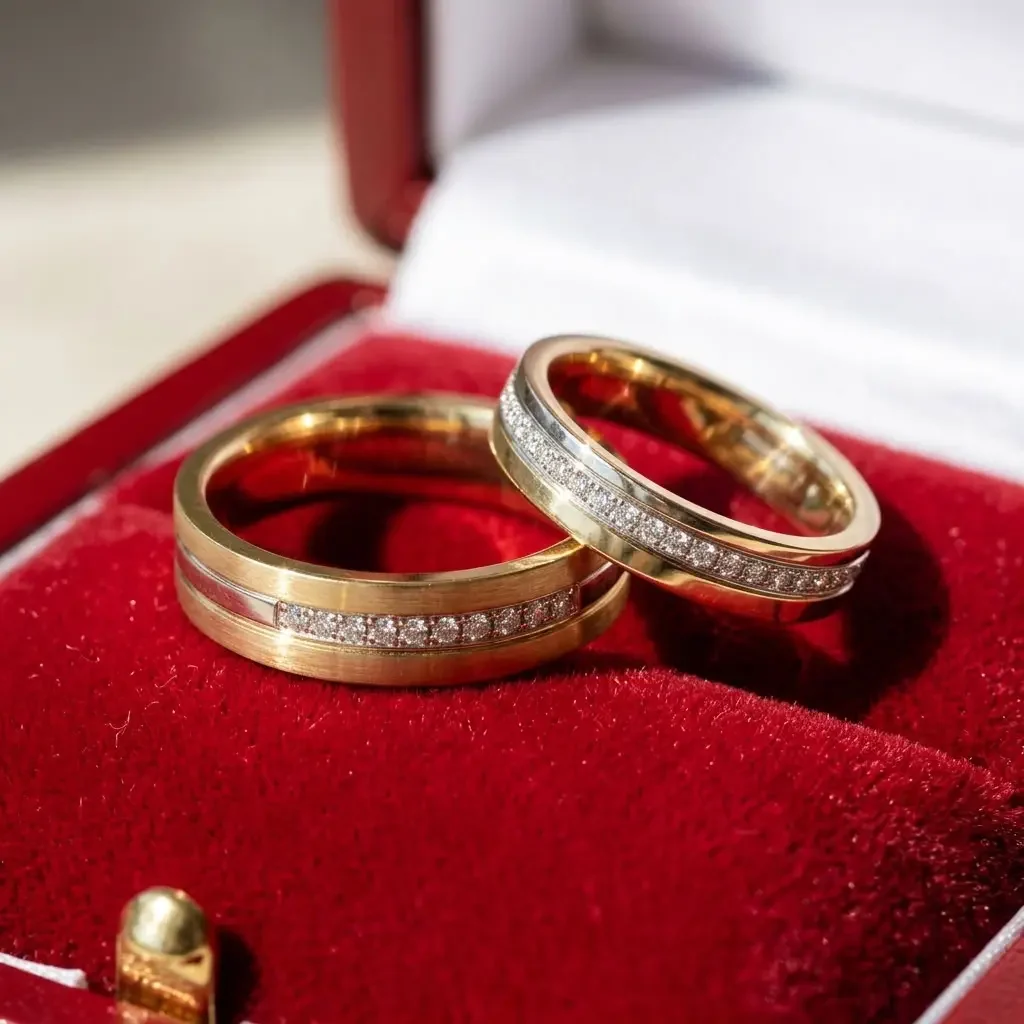
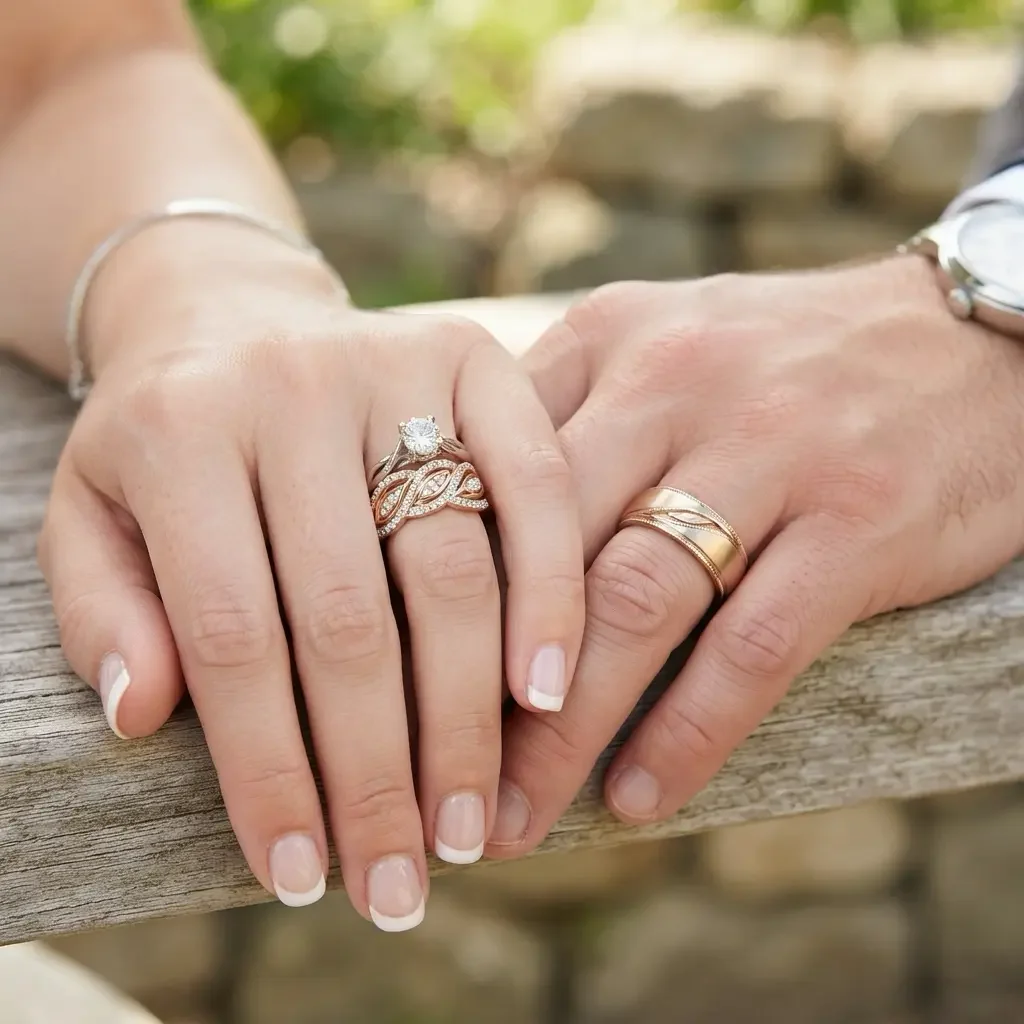
Most matching wedding bands are one design made in two sizes. It's basically the same profile, same detail, a wide version and a narrow one. It sounds right. On the hand, it often isn't.
The reason is physical. A milgrain edge that looks delicate on a 2mm band turns chunky stretched to 6mm. So when couples come into our Midtown studio asking for matching bands, the first question is what the two rings should share. Then each band gets drawn for the hand that's going to wear it.
Plenty of our couples aren't a his-and-hers pair at all. The advice is the same.
Key Takeaways
Custom matching wedding bands look best when they share one or two elements, usually metal color and finish, and each band is designed for its own width instead of scaled from the other.
- At The Custom Jeweler, both bands in a pair are modeled together in CAD, so details like milgrain are redrawn for each width rather than enlarged.
- If one partner wears an engagement ring, that partner's wedding band is designed first so it sits flush against the engagement ring. We often ask customer's to send their engagement ring or prodvide the CAD of the engagement ring. We can of course create both.
- The Custom Jeweler finishes most custom wedding bands four to six weeks after CAD approval, made in the USA.
By Matthew Howe, The Custom Jeweler. Updated October 1, 2026.
Decide What Your Matching Wedding Bands Share
Two bands look like a pair mostly because of three things: metal color, finish, and edge shape. Get those right and nearly everything else can differ. The usual ways couples tie bands together, from most visible to least:
- Same metal and finish, different widths. The simplest version, and honestly the one that ages best.
- One shared detail. A bevel, a hammered texture, a row of milgrain.
- A shared stone. Two small diamonds from a grandparent's ring, one in each band. That's remounting work, and one of our favorite requests.
- Something only you two see. The date engraved inside one band, the place inside the other.
Pick one. Maybe two.
Why a Matching Wedding Band Set Can't Just Be Scaled
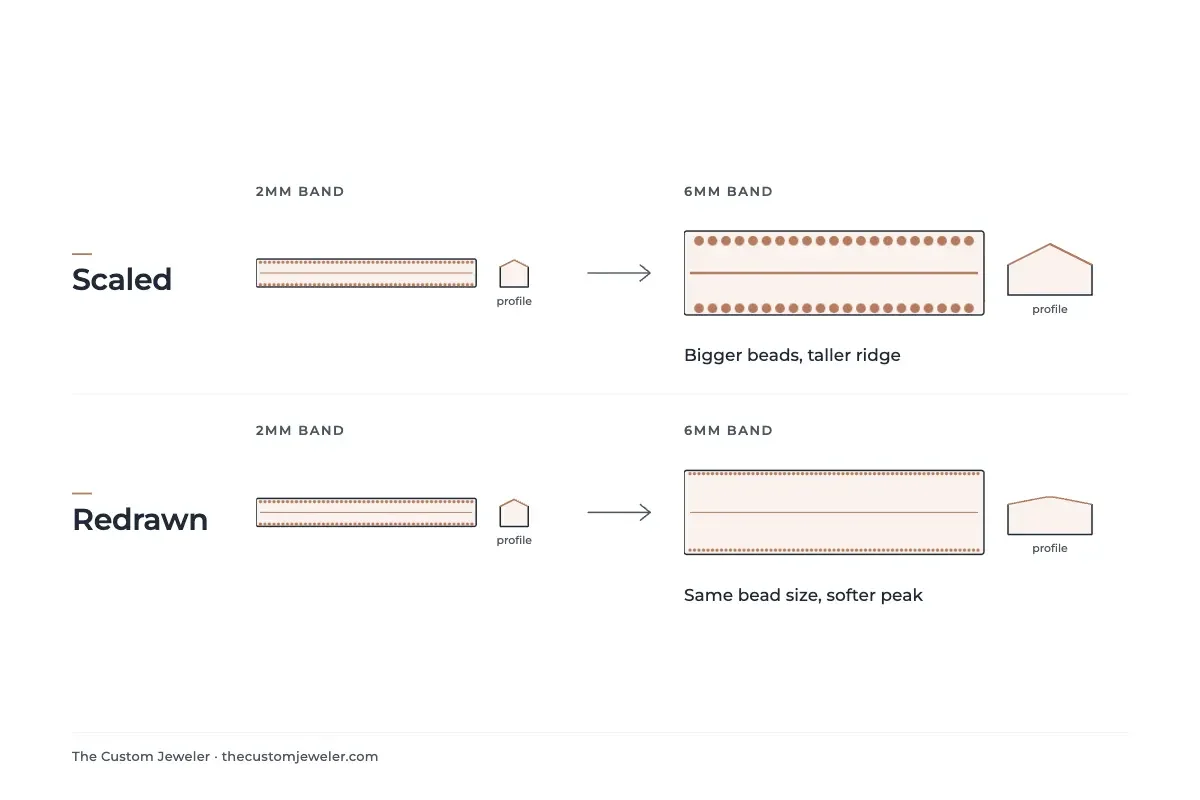
Milgrain is a row of tiny metal beads along a band's edge. Enlarge a narrow design to fit a wide band and the beads get bigger, and suddenly the edge looks like a bike chain. When we model a pair in CAD (computer-aided design, the 3D file your ring is cast from), the beads stay roughly the same size on both. The wider band just gets more of them.
Same with a knife edge, the peaked ridge down the center of some bands. Crisp at 2mm. At 6mm, it's a roof. We usually lower the peak on the wider band.
[IMAGE 2: matching-wedding-bands-cad-render-milgrain.webp | Alt: CAD render of two matching wedding bands with milgrain redrawn at the same bead size on a narrow and a wide band]
Width works as a ratio. Something like 2mm with 5mm, or 2.5mm with 6mm, looks deliberate. Two bands of nearly the same width often look less matched, oddly, than two that clearly differ. Thickness gets set alongside: too thin and a wide band can bend out of round, too thick and it sits like a washer.
Got an Engagement Ring? Design That Band First
The engagement ring sets the rules. A low-set center stone, a halo, or a shoulder that sweeps down toward the finger all stop a straight band from sitting flush.
Two fixes. Contour the wedding band to curve around the engagement ring. Or, if the custom engagement ring is being made at the same time, raise the setting slightly so a straight band slides underneath. We prefer the second. Simple bands are much easier to match.
Then the partner's band gets designed to fit the first. Reverse that order and the narrow band may not sit next to the ring it lives with.
His and Hers Wedding Bands for Two Different Lives
Matching the color doesn't mean matching the alloy. If one of you works with your hands (nurses, chefs, anyone who lifts things for a living), 14k gold holds up better than 18k because it's harder. The other partner can wear 18k in the same color. 18k yellow does run a little richer, so if color is the whole point, keep both in one karat.
Finish is a decision thats has implications. Matte can show scratches. A satin center with polished edges holds up better, and it doubles as a shared detail.
Either way, check the stamp inside each band: 14K, 18K, or PLAT. The FTC's Jewelry Guides cover those marks, so they mean something.
Sizing Two Very Different Hands
Wide bands fit tighter than narrow ones in the same size, so get sized in the width you're ordering. Measure in the afternoon. Fingers swell in summer, too, so a February sizing might not hold in July.
Eternity bands and patterns that wrap all the way around are hard to resize cleanly. Get it right once.
Timing and Budget for Custom Matching Wedding Bands
Order both together: one consultation, one CAD file with both rings on screen, revisions before anything's cast. At The Custom Jeweler, most custom wedding bands are finished two to three weeks after CAD approval. Large national builders often quote six to eight. We'd still start about eight weeks out, which leaves room for a resize.
The two bands almost never cost the same. A plain 6mm band uses far more metal than a 2mm one, and metal prices move week to week. Add diamonds to the narrow band and the math flips. You'll get a real number after the consultation, once metal, width, and stones are settled.
Not sure what you want? Our AI ring design tool lets you try out both bands first. Bring screenshots. They help.
Matching Wedding Bands FAQs
Do wedding bands have to match?
No. There's no rule, and plenty of couples wear bands that look nothing alike. If you do want them to read as a pair, sharing metal color and finish does most of the work. A single shared detail or an engraving that links the two bands covers the rest.
What width should his and hers wedding bands be?
Common pairings are around 2mm with 5mm, or 2.5mm with 6mm. The right width depends on finger size and, for the partner with an engagement ring, how the band sits beside it. Bands that clearly differ in width usually look more intentional than two that are almost the same.
How long do custom matching wedding bands take?
At The Custom Jeweler, most custom wedding bands are finished four to six weeks typically after the CAD design is approved, and both bands in a pair are made together. We recommend starting about eight weeks before the wedding to leave room for sizing checks and revisions.
Can we use stones from a family ring in both wedding bands?
Often, yes. Small side stones from an older ring can be split between two new bands, one in each. We check the stones first for condition and size, since some older stones are chipped or too small to set securely in a band.
Start your custom wedding band project online, or book a free consultation at our studio at 2 West 45th Street. Bring both hands.

Matthew Howe - Director of Operations — The Custom Jeweler
Matthew Howe has worked in diamonds since 2012, spending his first years alongside the buyers at a recycled and estate diamond wholesaler — learning how stones are graded, priced, and marked up well before they reach a retail case. He runs The Custom Jeweler day to day and still works client projects himself: the first call, the stone list, CAD approvals, and the last photos before a piece ships. Most of what he writes started as a question a client asked him on the phone.
.webp)