


His and Hers Custom Wedding Bands: How to Design Matching Rings That Still Feel Personal
Bridal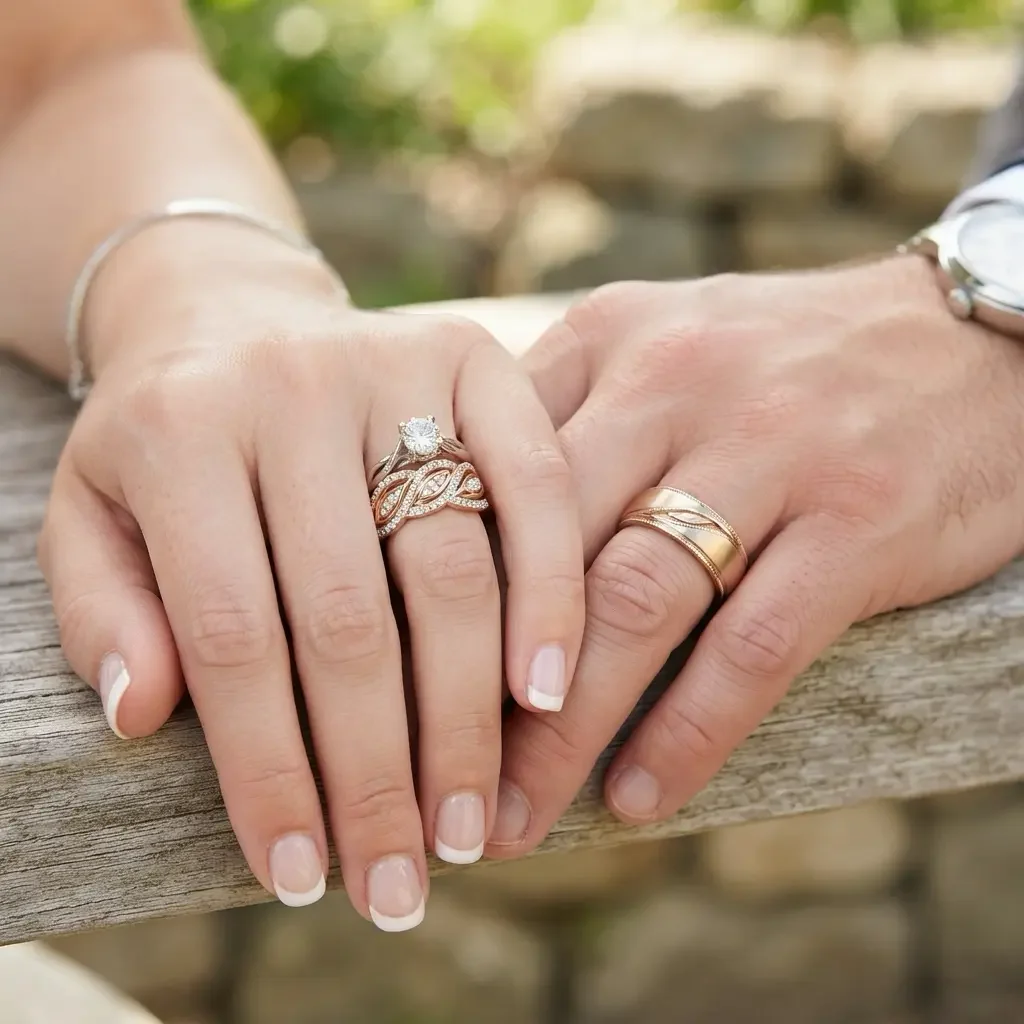
His and Hers Custom Wedding Bands: How to Design Matching Rings That Still Feel Personal
Most wedding band consultations I sit in on start the same way. One person arrives with a folder of screenshots. The other one says "something simple, I guess," and means it. Both of them want the rings to relate to each other somehow, and neither one wants to be the person wearing a ring they got talked into.
That's more solvable than couples expect, because "matching" turns out to be a much looser requirement than the word suggests. In most of the pairs we build, the strongest connection between the two rings is the part nobody else will ever see.
Here's how we work through it, including the situations where I'd tell one of you to go buy a band retail.
What "Matching" Actually Means
When couples say they want matching bands, they usually mean one of three fairly different things, and it saves a lot of time to sort out which one before any design work starts.
A small number genuinely want identical rings, one design scaled to two hands. It's the version most people picture when they say the word, and it's the version that gives us the most trouble, for reasons I'll get to.
Most couples actually want coordinated rings. Same metal, same finish, maybe one shared element like a milgrain edge or a center groove, with each band otherwise built around the person wearing it. Together on two hands they obviously belong to each other. Separately, each one looks like a ring that person would have chosen on their own. This is where the majority of our band projects land.
The third version is quieter. Two rings that look nothing alike from the outside, connected somewhere private: a stone set inside each band, an engraving in the other person's handwriting, the same date cut into two completely different rings. Some of the best pairs we've made match nowhere except the interior.
All three are legitimate. Just know which one you're asking for, because the answer changes almost every decision that comes after it.
The Match Lives in Metal and Finish
If you take one practical thing from this article, take this one. Two bands in the same metal with the same surface finish will read as a pair even when the designs have nothing in common. A 6mm brushed yellow gold band next to a 2mm brushed yellow gold band with a row of pavé looks completely intentional. The eye connects color and texture long before it starts comparing shapes.
The reverse causes more trouble than people expect. Order "matching" 14k white gold bands from two different sources and there's a real chance they won't match, because white gold isn't one color. Every manufacturer alloys it differently, some leaning warm and some leaning gray, and rhodium plating hides the difference right up until it wears through. We've had couples bring in two white gold bands bought a year apart that sit visibly off from each other in ordinary daylight.
When both bands are one project, they're cast from the same alloy batch and finished by the same hands in the same week. It's the only reliable way to get two rings that are truly the same color, and it's a good argument for designing them together even when the designs themselves share nothing at all.
Where Identical Falls Apart
The usual request is his band at 5 to 6mm and hers at 2 to 3mm, same design, half the width. Some things survive that reduction and some things don't, and the split is fairly predictable once you know what to look for.
Surface treatments scale fine. Hammered, brushed, sandblast, a knife-edge profile: all of these look right at any width, because a texture doesn't care how much room it's given. It just fills whatever it has.
Patterns are where it gets difficult. A rope or braid detail that reads clearly at 6mm turns into visual noise at 2.5mm. Engraved scrollwork compresses badly, and the negative space between the cuts disappears well before the cuts themselves do.
Milgrain is the specific one worth understanding, because it's the detail couples request most often and the one that scales worst. Milgrain beads are cut with a wheel, and the wheel comes in fixed sizes. You can't shrink milgrain proportionally the way you'd shrink a drawing. A double row that sits comfortably on a 6mm band has to become a single row on a 2mm band, or the beads have to come off a smaller wheel, which changes how the edge catches light. Either way, the narrow band's milgrain is a different detail from the wide band's, and pretending otherwise produces a ring that just looks crowded.
Pavé runs into the same wall from the other direction. The stones you can set are limited by how much metal is left once the seats are cut. A 6mm band can carry larger melee, or two rows, or a wider spread across the top. A 2mm band is realistically a single row of small stones, and pushing the stone size up to match his means cutting into wall the band needs in order to survive being worn every day.
So when a couple wants a patterned pair, we generally redraw the pattern for the narrow band instead of scaling it. Keep the motif, change the proportions, let each band carry the detail at a size that actually works at that width. On paper the two rings stop being identical. On the hands, that's the point where they finally start looking like they are.
Weight is the difference nobody anticipates. A 6mm comfort-fit band in 14k gold has real mass to it, often 8 grams and up depending on size and thickness, and plenty of men who've never worn a ring before find that weight reassuring rather than annoying. Build the same wall thickness into a 2mm band and it wears like a wire. Comfort fit makes it worse, since the domed interior removes metal from a band that didn't have much to spare. A narrow band needs its own thickness spec, worked out for its own width, instead of inherited from his.
Her Band Has a Third Ring in the Conversation
His band only has to get along with his hand. Her band usually has to sit against an engagement ring every day for the next several decades, which changes the design question completely.
If the engagement ring has a low-set center or a straight profile, a straight wedding band sits flush against it and there's nothing to solve. If it has a larger center stone, a cathedral setting, or a halo, a straight band will either gap away from the ring or grind against it. The fix is a contoured band shaped to trace that specific engagement ring, and contoured bands are close to impossible to buy off the shelf in a shape that actually fits. This is the single most common reason her band ends up custom even when his doesn't.
It also means her band is answering to two designs at once. Our advice, almost every time: the engagement ring wins. Her band should fit and complement the ring it lives next to, and the connection to his band should move into metal, finish, and whatever goes on the inside. A band that coordinates beautifully with his ring but fights her engagement ring is a band that ends up in a drawer.
You Don't Have to Match Metals Either
Some couples shouldn't. Skin tone is part of it, since yellow gold flatters some hands and washes out on others, but lifestyle usually matters more.
If one of you works with your hands, metal choice becomes a durability question before it's a style question. Platinum and gold wear in opposite ways. Scratch platinum and the metal displaces and stays on the ring, which is why old platinum develops that soft gray patina instead of getting thin. Gold sheds. A gold band worn hard for twenty years is measurably lighter than the day it was made. For someone in the trades we'll usually steer toward platinum, or a lower-karat gold in a thicker spec, whatever their partner happens to be wearing.
If you end up in different metals and still want a visible link, a two-tone detail handles it. A platinum band with a yellow gold inlay line, worn alongside her yellow gold band, ties the pair together without putting either person in a metal they didn't want.
The Inside Is Where "Personal" Actually Happens
Everything above is about how the rings look to other people. This part is about the two of you, and it's the part couples tend to care about most a year later.
The interior of a band is usable space, and most of it goes unused. Handwriting engraving is the one we do most: each ring carries a word or phrase in the other person's actual handwriting, scanned from a written sample. A date or a set of coordinates in a clean engraved line is a classic for good reason. A small stone set flush into the inside of the band, a sapphire, a birthstone, a tiny diamond pulled from a family piece, sits against the finger where only the wearer knows it's there.
One pair I still think about: he wanted a plain 6mm platinum band with a satin finish, she wanted a contoured rose gold band with pavé along the shoulders. Nothing about them matched. We set a small sapphire flush into the interior of each ring and engraved the same three words inside both, each in the other person's handwriting. Nobody looking at those two rings would guess they were made together. That was more or less the point.
These details cost relatively little, they leave the exterior design completely alone, and they solve the original problem outright. Two people with entirely different taste can wear two entirely different rings that are, in the only sense that matters to them, a matched set.
The Honest Price Part
Designing two bands together does not cost twice the design work. It's one project, one consultation, one round of CAD with both rings rendered side by side so you can see the pair as a pair before anything gets cast. Where the second ring is a variation on the first, the design portion of the cost drops further.
That said, we'll repeat what we've said elsewhere on this site: if one of you wants a plain comfort-fit band with no detail, no stones, and nothing inside it, a store-bought band is a perfectly good answer, and under about $600 it's usually the better one. There's nothing to customize on a plain band. The honest move in that case is to put the budget into the ring that actually has a design in it, and if color matching matters to you, bring the retail band in so we can match the alloy tone as closely as the finish work allows.
Where custom earns its cost on bands: contoured shapes fitted to an engagement ring, patterns redrawn for each width, mixed-metal details, interior stones and handwriting work, and heavier wall specs than retail bands carry. Same principle as everything else we build. You're paying for metal and labor, not for a case in a mall.
How the Process Works for a Pair
One consultation covers both rings. Bring the engagement ring if there is one, since her band gets designed against it, and bring whatever references either of you has, even if that's nothing at all. We sort out which version of "matching" you're after, then build both bands in a single CAD project and send renderings of the pair together.
Revisions are unlimited before production, and with pairs we'd rather run three extra rounds of CAD than let one ring get compromised. Both bands are cast from the same batch, finished together, and shipped together. Timeline is the same four to eight weeks as any custom wedding band project, so working backward from the wedding date, three months out is comfortable and two months is fine.
Frequently Asked Questions
Do his and hers wedding bands have to match?
No. Once couples see the options, most decide against truly identical rings. The three workable approaches are exact matching, shared metal and finish with different designs, or a connection hidden on the interior. The middle option is the most common by a wide margin.
Can we use different metals for our wedding bands?
Yes, and sometimes you should. Skin tone, personal style, and how hard each of you is on your hands all point toward different answers. If one of you needs platinum for durability reasons, that shouldn't force the other person into platinum too. A two-tone inlay can link the pair visually if you want the connection to be visible.
Can our handwriting be engraved inside the rings?
Yes. Write the phrase on plain paper in pen, photograph or scan it, and send it over. We convert it to a cut path and engrave it into your partner's band. Longer phrases need a wider band to sit comfortably, so it's worth raising early rather than after the width is locked.
How much do custom matching wedding bands cost?
Less than two separate custom projects, because both rings share a single design process. Beyond that it comes down to metal, finished weight, and how much detail and stone work each band carries. The one exception is a plain unadorned band, where retail is usually cheaper and we'll say so.
How long do custom wedding bands take?
Four to eight weeks from consultation to finished rings, with both bands produced together. Start roughly three months before the wedding. Two months is workable, but it removes the room to change your mind at the CAD stage.
Can her band be shaped to fit around an engagement ring?
Yes, and it's one of the most common things we build. We design the contour against the actual engagement ring rather than a photograph, which is why we ask you to bring it in or ship it to us. Off-the-shelf contoured bands are cut to generic profiles and rarely close the gap properly.
Should we design both bands at the same time?
If color matching matters to you, yes. Rings cast from the same alloy batch and finished in the same week are the only ones guaranteed to be the same shade, which matters most in white gold. If one of you is buying retail, bring that band to the consultation so we can match against it.
Where to Start
If the two of you aren't aligned yet, that's normal, and it's far easier to react to a picture than to describe a ring from nothing. Our AI ring design tool turns a description into a visual in a couple of minutes, and generating a few versions of each band is a fast way to find out what each of you actually likes before anyone commits to anything.
When you're ready, consultations are free and there's no obligation to move forward. Bring the engagement ring, bring your screenshots, or bring nothing at all. We'll tell you honestly which parts of your pair are worth building custom, including the parts that aren't.
The Custom Jeweler — 2 West 45th Street, Suite 1705, New York, NY
Written by Matthew Howe, Director of Sales & Marketing at The Custom Jeweler. We design and manufacture custom engagement rings, wedding bands, pendants, and earrings out of our office on West 45th Street, and all production is done in the USA.

Matthew Howe - Director of Operations — The Custom Jeweler
Matthew Howe has worked in diamonds since 2012, spending his first years alongside the buyers at a recycled and estate diamond wholesaler — learning how stones are graded, priced, and marked up well before they reach a retail case. He runs The Custom Jeweler day to day and still works client projects himself: the first call, the stone list, CAD approvals, and the last photos before a piece ships. Most of what he writes started as a question a client asked him on the phone.
.webp)
.webp)