


What to Know Before Designing a Custom Engagement Ring
Bridal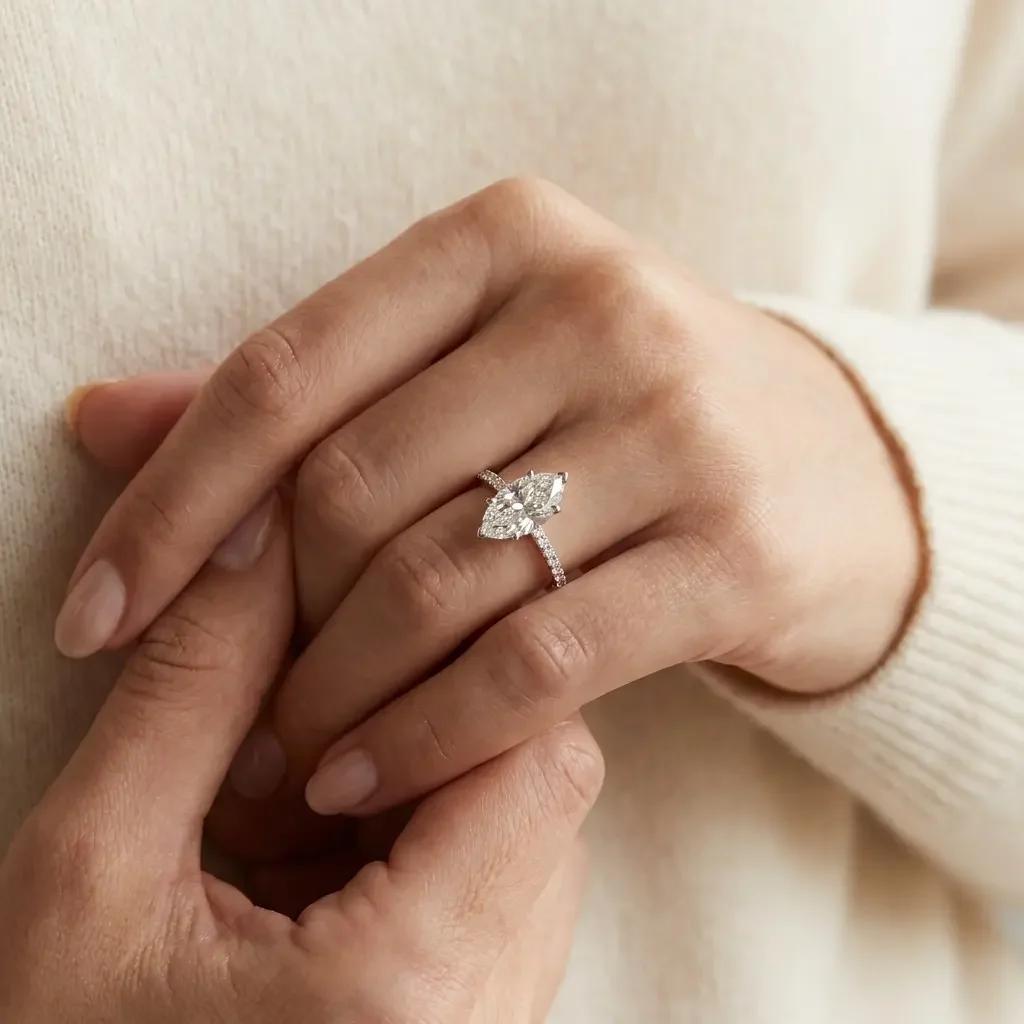
What to Know Before Designing a Custom Engagement Ring
When it comes to engagement rings, off-the-shelf options don't work for everyone. Maybe you've scrolled through hundreds of designs online without finding "the one," or perhaps you want something that tells your unique story. That's where custom design comes in—and yes, it's more approachable than you might think.
How Much Should You Know Before Meeting with Jewelers?
Here's the thing: you don't need a Pinterest board with 500 pins or a PowerPoint presentation (though some people actually do show up with those). A rough idea of what you're drawn to helps, but jewelers are used to working with everything from "I have no clue" to "here are my exact specifications down to the millimeter."
If you're planning a surprise proposal, do a bit of detective work. Most people drop hints—sometimes subtle, sometimes not. Pay attention to comments about friends' rings, Instagram saves, or offhand mentions of styles they love. Jewelers say most clients walk in with at least something to work with: a screenshot from Instagram, a general vibe like "classic but not boring," or knowledge that thin bands are a must.
When someone's completely stumped about their partner's preferences, good jewelers turn into part-detective, part-therapist. They'll ask about lifestyle (desk job or working with hands?), personality, and fashion sense. Some even scroll through the recipient's Instagram—not in a creepy way, but to understand their aesthetic. Bonus: photos showing hands can help determine which diamond shapes are most flattering for their finger shape.
Finding the Right Jeweler
Shopping for a jeweler is sort of like dating—you need the right vibe and, more importantly, someone you can trust with a significant chunk of money.
Can they actually execute your vision? This isn't the time for "close enough." Look through their portfolio. If you're dreaming of something vintage-inspired and all you see are ultra-modern geometric designs, that's a mismatch. You want someone whose work makes you think, "Yes, they get it." They should be able to take your half-formed ideas and turn them into something even better than you imagined—or guide you from ground zero if you're starting with a blank slate.
Do they seem trustworthy? This matters even more than aesthetic. You're probably not a diamond expert (most people aren't), so you need someone who won't take advantage of that. Red flags include vague answers, reluctance to explain their pricing, or that nagging feeling something's off.
Ask the important questions:
- Is this diamond certified by GIA? (That's the gold standard—more on why that matters later)
- What's your warranty situation?
- Can you walk me through why this diamond is the right choice for my budget?
If they're dodging questions or making you feel dumb for asking, walk away. The right jeweler makes this stuff understandable without the condescension.
Red Flags to Watch For
A few warning signs should have you reconsidering—or at least asking more questions:
They only sell what they own. If a jeweler's diamond selection is limited to what's physically in their safe, your options are limited too. Unless you're dealing with a huge retailer with massive inventory, jewelers should be sourcing from worldwide markets. That's how you get the best stone for your budget, not just the best one they happen to have sitting around.
They're pushing EGL certificates. You'll hear some jewelers say EGL (European Gemological Lab) certified diamonds are "just as good" as GIA. They're not. EGL is a commercial lab with looser standards, and unless you know how to read between the lines on their reports—which most people don't—you could end up overpaying for a stone that's actually lower quality than advertised. Stick with GIA certification.
Everything's pre-made. Some jewelers use mass-produced settings where they basically drop your diamond into an existing mount and call it a day. Sure, the stone will be secure, but it won't have that custom fit or sit as nicely on the finger. Real custom work means the setting is built specifically for your diamond—precise, low-profile, perfectly proportioned. Ask directly: "Is this a pre-made setting, or are you building it custom for my stone?"
The First Meeting: Picking Your Diamond
Most jewelers start with the diamond, and it makes sense—this is where most of your budget goes. It's the foundation of everything else. The only exception? If you've got some wildly elaborate setting in mind that needs a very specific stone shape or size.
Why start here? Simple: you can always change the setting down the road if you get bored or your style evolves. But the diamond? That's forever (or at least, it should be).
The first appointment usually involves trying on actual diamonds. Not just looking at them under those harsh jewelry store lights, but putting them on your finger (or your partner's) to see how different sizes actually look in real life. What seems perfect in a display case might look too big or too small once it's on a hand. Most people are surprised by this.
Jewelers typically pull a curated selection based on what you've told them you want. Maybe you're torn between shapes, so they'll show you rounds, ovals, and emerald cuts. Or maybe you're dead-set on an oval—then it becomes about finding the *right* oval. Length-to-width ratio, brilliance, that perfect balance of size and quality within your budget.
A good jeweler doesn't keep a massive diamond inventory locked in the back. They source globally, which means they can find the best options for what you actually want instead of pushing whatever they happen to own.
After Selecting Your Diamond
Once you've nailed down the center stone, it's time for the fun part: designing the actual ring.
For more detailed designs—think side stones, halos, or accent gems—your jeweler will source additional stones to complement your center diamond. This is where things get hands-on. Literally. You might find yourself hovering over a tray of loose stones, moving them around like pieces of a puzzle until the arrangement clicks. The goal? Make sure your center diamond stays the star while the supporting stones add that extra something.
Want to incorporate birthstones? Anniversary dates hidden inside the band? This is when those details come in. Even simpler designs can have personal touches. Maybe you go with a hidden halo (sparkle underneath where only you know it's there), mix metals for the band and prongs, or add a tiny engraving inside.
This is also when your jeweler breaks out the CAD software—Computer-Aided Design, basically fancy 3D modeling for jewelry. They'll create digital renderings so you can see exactly what the ring will look like from every angle before anyone starts actually making it. Some jewelers also do hand-drawn sketches, which honestly can be really cool to keep afterward.
Everything gets locked in at this stage: the exact positioning of every stone, metal choices, band width, all of it. No surprises later.
Getting the Ring Size Right
This seems simple until it's not. Ring sizing can be surprisingly tricky.
If you're going the surprise route and have no idea what size to get, here's a helpful baseline: the average ring size in the U.S. is 6. Not a guarantee, but a decent educated guess. And here's the good news—rings can be resized if needed, so it's not the end of the world if you're a half size off.
For those getting measured in person, timing actually matters. Get measured when your fingers are at a normal temperature—not right after a hot yoga class when everything's swollen, and not after coming in from freezing cold when your fingers have shrunk. Both will give you wildly inaccurate measurements.
What does the right fit feel like? It should slide on without too much resistance, but you should have to give it a little wiggle to get it back off. It shouldn't spin around on your finger, but it also shouldn't be so tight that you're panicking about cutting off circulation. There's a sweet spot, and any decent jeweler knows how to find it.
Design Considerations
Think about real life. Be honest about lifestyle here. If you're constantly using your hands—typing all day, at the gym, gardening, working on cars—you might want a thicker, sturdier band. Gold is soft. It's going to bend if you slam it in a car door or accidentally step on it (yes, this happens). A beefier band holds up better to daily wear and tear.
That said, no ring is indestructible. Even the most expensive ring from the fanciest jeweler will bend under enough force because physics. What matters is finding a jeweler who'll fix it when life happens. Look for lifetime warranties on custom pieces—it's worth it.
Timeless vs. trendy: does it actually matter? People stress about this way more than necessary. Here's the reality: if you love your ring for 10 years, that's a fantastic run. And guess what? You can change the setting later if you want. The setting is the cheap part of the equation compared to the diamond.
Don't pick something so safe and traditional that you're already bored with it before the proposal even happens. But also, maybe don't go so aggressively trendy that you'll be over it in two years. Somewhere in the middle—something that feels like *you* right now, with enough classic elements that it won't look dated in old photos.
Don't Forget About the Wedding Band
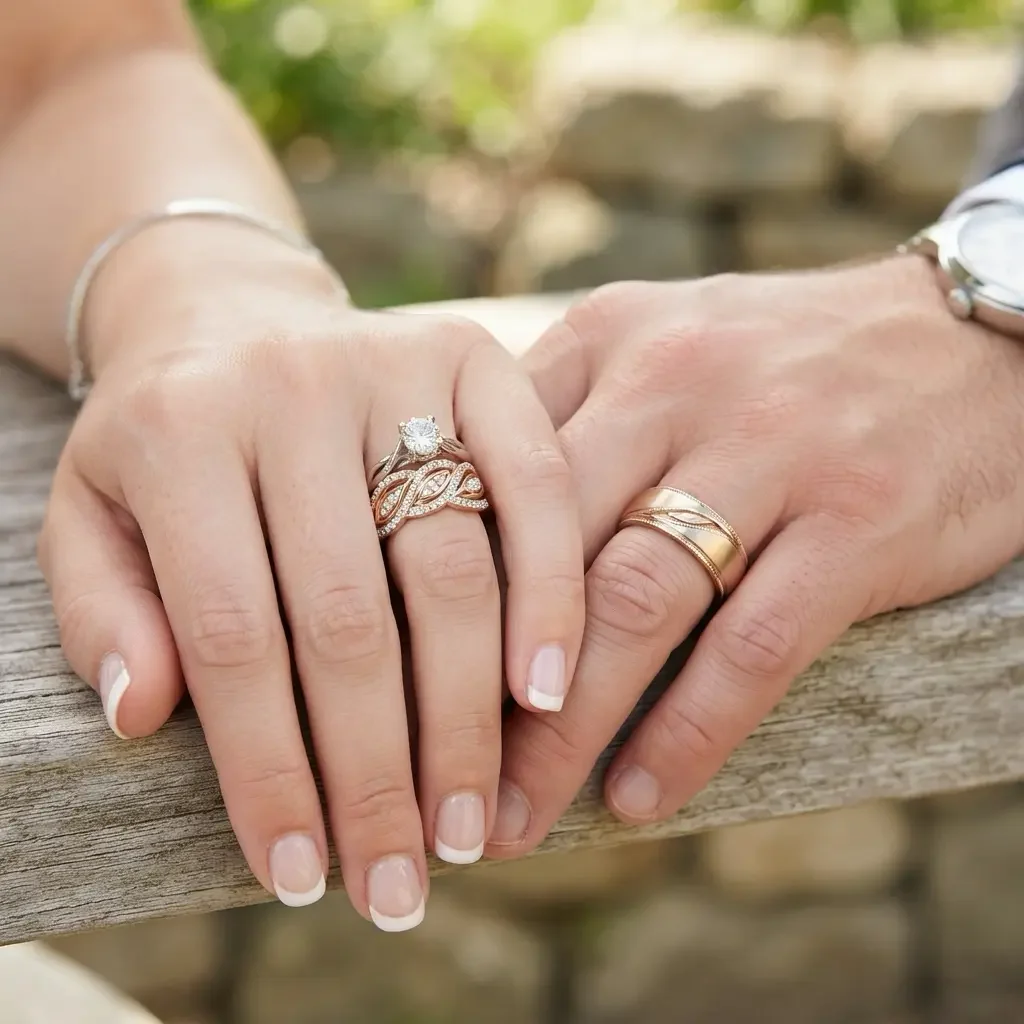
This is one of those things people don't think about until it's too late. You're going to wear your engagement ring solo for maybe a year, year and a half tops. Then comes the wedding band, and suddenly you've got two rings that need to play nicely together.
This especially matters if you're going with an elongated stone—ovals, marquises, pears, anything that comes to a point or has length to it. If your engagement ring sits too low, the wedding band will literally bang into the center stone every time you move your hand. Annoying at best, potentially damaging at worst.
The fix? Make sure your jeweler designs the engagement ring with the wedding band in mind from the start. Cathedral settings (where the center stone sits up a bit higher) are great for this. The wedding band slides right underneath without any awkward gaps or rubbing.
Also worth thinking about: proportions. Your engagement ring is probably the bigger investment and should stay the star of the show. Your wedding band should complement it, not compete with it or make it look smaller by comparison.
What Happens During Production
Once everything's approved, the real work begins. Here's the behind-the-scenes process most people never see:
First, there's the CAD model (which you've already approved), then a wax mold gets created from those specs. Some jewelers will have you come in to try on this wax version—it's fragile, so you can't exactly wear it around, but you can slip it on carefully to check fit and proportions one last time.
Then comes casting. They pour molten gold or platinum into the mold, and what comes out looks... rough. Really rough. The prongs are way too tall, everything's thicker than the final product should be, and it basically looks nothing like what you're expecting. That's normal.
This is where the real craftsmanship happens. Skilled artisans hand-shape everything, set your diamonds with precision, position the prongs, and start the tedious polishing process. This step separates good jewelers from mediocre ones. Done wrong, the ring might look okay but won't be structurally sound. Done right, it'll last generations.
The prongs get shaved down so they're small enough to be nearly invisible but still strong enough to keep your diamonds locked in place. You don't want prongs catching on your sweaters, but you definitely don't want them so small that stones start popping out.
After all that, the ring goes through quality control that's honestly kind of intense:
- - They verify it's the right diamond (sounds obvious, but mistakes happen)
- - Everything gets inspected under a microscope for chips or damage
- - They check for porosity—basically tiny holes in the metal that can weaken it
- - Confirm the prongs are pressed down completely
- - Make sure the head of the ring is securely attached to the band
- - Multiple checkpoints throughout the entire process to catch anything that's off
Only after it passes all those checks does it get shipped out.
How Long Does This Actually Take?
It depends. Shocking, right?
A simple solitaire with a straightforward design? Jewelers can rush that in a week or two if there's a proposal deadline looming. Though honestly, most prefer to take three to four weeks minimum to do everything properly without cutting corners or stressing everyone out.
More complex designs—anything with intricate side stones, mixed metals, elaborate details—take longer. Sometimes a lot longer. We're talking potentially several months from that first "so, what are you thinking?" conversation to holding the finished ring in your hand.
The timeline includes multiple touchpoints: choosing the diamond, refining the design (which might take a few rounds), trying on the wax model, waiting for production, and final quality checks. Each step takes time, and rushing any of them is asking for problems.
If you've got a specific proposal date in mind, work backward and add buffer time. Life happens, stones take longer to source than expected, that perfect design needs an extra tweak. Better to have the ring early than to be sweating bullets because it's cutting it close.
The Bottom Line
Designing a custom engagement ring isn't as scary as it seems. Yes, it's a big purchase and there are a lot of decisions to make, but that's also what makes it special. You're creating something that doesn't exist anywhere else in the world.
The key is finding the right jeweler—someone who gets your vision (even when you barely have one), explains things in actual English instead of industry jargon, and doesn't make you feel like you're being upsold at every turn. Transparency matters. So does craftsmanship. And honestly, so does just liking the person you're working with, because you'll be spending a fair amount of time together.
Ask questions. All the questions. About certifications, about their process, about what happens if something goes wrong down the road. The right jeweler won't be annoyed—they'll be happy you're engaged and informed.
And when you finally get that ring? It'll be worth the process. Because it's not just another ring from a display case. It's *the* ring, built specifically for the person wearing it, with your input and vision baked into every detail.

Matthew Howe - Director of Operations — The Custom Jeweler
Matthew Howe has worked in diamonds since 2012, spending his first years alongside the buyers at a recycled and estate diamond wholesaler — learning how stones are graded, priced, and marked up well before they reach a retail case. He runs The Custom Jeweler day to day and still works client projects himself: the first call, the stone list, CAD approvals, and the last photos before a piece ships. Most of what he writes started as a question a client asked him on the phone.

.webp)
.webp)