

Lab-Grown vs. Natural Diamonds: How To Choose For Custom Jewelry Projects
Custom Jewelry
Lab-Grown vs. Natural Diamonds: How To Choose For Custom Jewelry Projects
This is a question we hear customers ask all the time when they deciding on the specifics of a custom diamond jewelry project.
In this article we go over what matters when you're embarking on building a custom piece and trying to decide which route to follow.
What You're Actually Comparing
Before we go into the pros and cons, one thing worth knowing: chemically, physically, optically — they're the same stone. A gemologist with a loupe cannot tell the difference by looking it, thats where technology and detect machines come in. The gap is origin, and everything that follows from origin: price, rarity, market behavior, and the story you attach to it.
That's it. That's the whole debate, really.
Lab-Grown Diamonds: The Pros
1. The price difference is substantial — and it's not closing. Lab-grown diamonds currently run 70–80% less than comparable natural stones. A two-carat lab diamond that would cost $15,000 natural might run $2,500–$3,500 lab. That gap has actually widened over the last few years as lab-grown production has scaled. For custom work, this matters enormously — it means more budget goes toward the metalwork, the setting, the design details that actually make a piece distinctive.
2. You get more stone for your money. With the savings, clients routinely size up. The person who came in wanting a one-carat stone leaves with a 1.5 or two-carat — same budget, notably more presence. In custom jewelry where the stone is often the centerpiece, that's a real difference.
3. Consistency is genuinely better. Lab-grown diamonds are produced under controlled conditions, which means fewer inclusions, better color consistency, and a higher likelihood of getting exactly what you spec. When a custom design calls for a specific cut or proportion, a lab stone is easier to source to those specifications.
4. No supply chain uncertainty. Tracing the ethical origin of a mined diamond is possible but imperfect. Lab-grown eliminates that question entirely — you know exactly where it came from.
Lab-Grown Diamonds: The Cons
1. Resale value has collapsed. This is the honest truth: lab-grown diamonds resell for almost nothing right now. If you're buying a piece as an investment or plan to sell it someday, the economics don't work. The secondary market is essentially nonexistent at scale.
2. The romance argument is real for some people. This sounds soft, but it's legitimate. Some people want a stone that took a billion years to form. That meaning is personal, but it's not nothing. For a piece marking something significant — an engagement, a legacy, a major milestone — the origin story matters to certain buyers in a way that isn't irrational.
3. Long-term value trajectory is unknown. Natural diamonds have a few centuries of market history. Lab-grown stones are fifteen years old in meaningful commercial terms. Where their value sits in thirty years is genuinely unpredictable.
Natural Diamonds: The Pros
1. They hold value better — for now. The resale market for natural diamonds is established, even if it's not a great investment by any traditional metric. A well-graded natural stone retains more of its purchase price than a lab stone will today.
2. Rarity is tangible. Large, high-quality natural diamonds — anything above two carats in excellent cut, D-F color, VS clarity — are genuinely scarce. That scarcity is baked into the price, and for some pieces, it's exactly the point.
3. The emotional weight is real. Plenty of custom jewelry is about marking something. For clients who feel the geological age of a stone adds meaning to that marker, no amount of chemistry equivalence changes the experience of wearing it.
Natural Diamonds: The Cons
1. The premium is steep, and a lot of it is perception. Much of what you're paying for is marketing infrastructure built over decades. Whether that premium is worth it depends entirely on the buyer.
2. Quality at lower price points gets tricky. To hit a budget with a natural stone, something has to give — usually cut quality, color, or clarity. Lab-grown lets you keep all three.
So: Which One for Your Custom Project?
Ask yourself two questions.
Will this piece be passed down or sold? Natural.
Is this about the design, the moment, and the person wearing it — and the stone is a component of that, not the point? Lab-grown. Spend the difference on the metalwork.
There's no wrong answer. But there is an honest one for each situation.
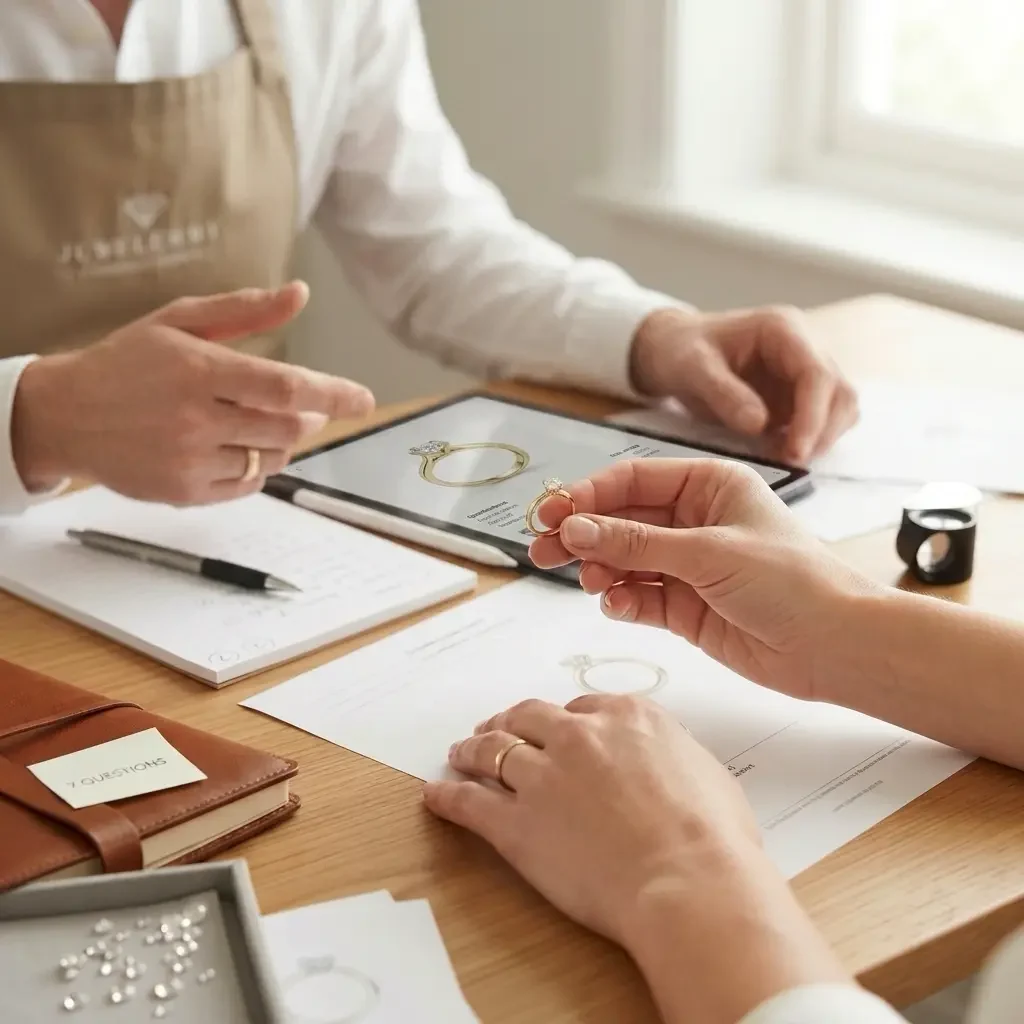
Working through a custom design and still not sure which direction makes sense? That's exactly what the first conversation is for. Set up an appointment here.

Matthew Howe - Director of Operations — The Custom Jeweler
Matthew Howe has worked in diamonds since 2012, spending his first years alongside the buyers at a recycled and estate diamond wholesaler — learning how stones are graded, priced, and marked up well before they reach a retail case. He runs The Custom Jeweler day to day and still works client projects himself: the first call, the stone list, CAD approvals, and the last photos before a piece ships. Most of what he writes started as a question a client asked him on the phone.