


Custom Jewelry Online vs. a Local Jeweler: What's Actually Different
Custom Jewelry
Custom Jewelry Online vs. a Local Jeweler: How to Tell Which One Fits
Most people frame this as a website versus a store you can walk into. The more useful question is who's doing the work — whether the person you're talking to controls the design file and the bench where the stones get set, or whether they're relaying your idea to people you'll never meet.
There are local jewelers with a real shop in the back and a bench jeweler who's been there twenty years. There are also websites that put a "customize" button on a catalog. And the reverse of both. Location by itself tells you almost nothing. Here's what does, plus where each option falls short.
Three different things get called custom
Three setups all get sold under the same word, and the difference shows up in your price and in how much control you have when you want a change.
- A store that sends the work out. You describe what you want to a salesperson, who passes notes to an outside CAD designer, who sends a file to a trade shop that casts and sets it. This arrangement is common and mostly honest. But every revision travels through a middleman, and the price has to cover three businesses.
- A shop that does its own work. Design in-house, casting in-house or with one partner they've used for years, setting at their own bench. This exists both locally and online. It's the setup you want, mostly because when you say "the ring looks too tall from the side," someone can answer you instead of asking around.
- A configurator. Pick a setting, pick a stone, done. Nothing wrong with it and the prices are usually fair. But it's assembly, not design. If the photo you saved has a specific prong shape or an unusual basket, a configurator won't get you there.
The easiest way to tell them apart is to ask who draws the CAD and where the ring gets made. A shop that does its own work answers in a sentence. A shop that doesn't will steer you toward talking about service instead.
Where the price difference comes from
Most of it is fixed cost. A store on a busy retail street pays rent on that street, plus the security buildout, insurance on everything in the cases, and a sales floor. Those bills arrive whether or not anybody comes in on a wet Tuesday, and they get spread across the people who do.
There's a second layer most buyers never hear about. Independent jewelers generally don't own the diamonds sitting in their cases. Those stones are on memo from a dealer, and the store's margin sits on top of the dealer's margin. When a store says they can get you anything, what they mean is that they can reach the same wholesale lists everyone else reaches, with one more person taking a cut along the way.
An appointment-based studio in an office building carries less of that overhead. Lower overhead only helps you if it reaches the quote, though, so stop comparing final numbers and start asking for the breakdown. A quote you can trust shows you:
- The center stone specs and the grading report number, so you can look it up yourself
- Metal karat and the estimated finished weight of the piece in grams
- Total carat weight and quality of the small stones, and how they're being set
- Labor listed separately from materials
- Whether the price is locked once you approve the design, or can still move
A client brought me a competing quote for a three-stone ring last spring. The two numbers were about $600 apart and the renderings looked interchangeable. Almost all of the gap was metal: the other setting was drawn at 7.6 grams in 14k white, ours at 4.9. Nobody was overcharging anyone. One ring simply had more gold in it, and neither quote said so anywhere on its face.
Gram weight is the line almost everyone skips and the one that quietly moves the number. Two rings can be indistinguishable in a rendering and three or four grams apart once they exist. If a shop won't tell you the finished weight, the quote isn't itemized.
Picking the stone
This is where buying online has the clearest advantage, and it isn't close. A local case holds whatever that store decided to stock, usually weighted toward the sizes that sell well in that area. A studio quoting from virtual inventory is sorting thousands of certified stones by the measurements that determine how a diamond looks: depth and table percentages, crown and pavilion angles, girdle thickness, fluorescence.
"Excellent cut" covers a lot of ground. Two stones at the same grade and the same weight can look different across a dinner table. So don't stop at the grade. Ask for the plotting diagram showing where the inclusions sit, and a high-magnification video you can watch yourself. Any studio doing this seriously will have opinions about which stones on a list are worth the money and which are cheap for a reason.
The counterpoint is fair: putting three stones side by side, in the same light, on your own hand is useful, and it takes more effort to arrange remotely. Ask the studio to bring in two or three candidates and film them together in one shot under one light source. That beats looking at stones in two different stores a week apart under two completely different lighting setups, which is what comparison shopping usually turns into.
You're approving a screen either way
Whatever the sales pitch sounds like, custom jewelry today is designed on a computer and cast from a printed model. Someone sketching on paper and carving wax by hand still exists, mainly for restoration and hand-fabricated work, but a new engagement ring is getting modeled digitally. That erases a good chunk of the in-person advantage, because you're looking at a rendering on a screen in both cases.
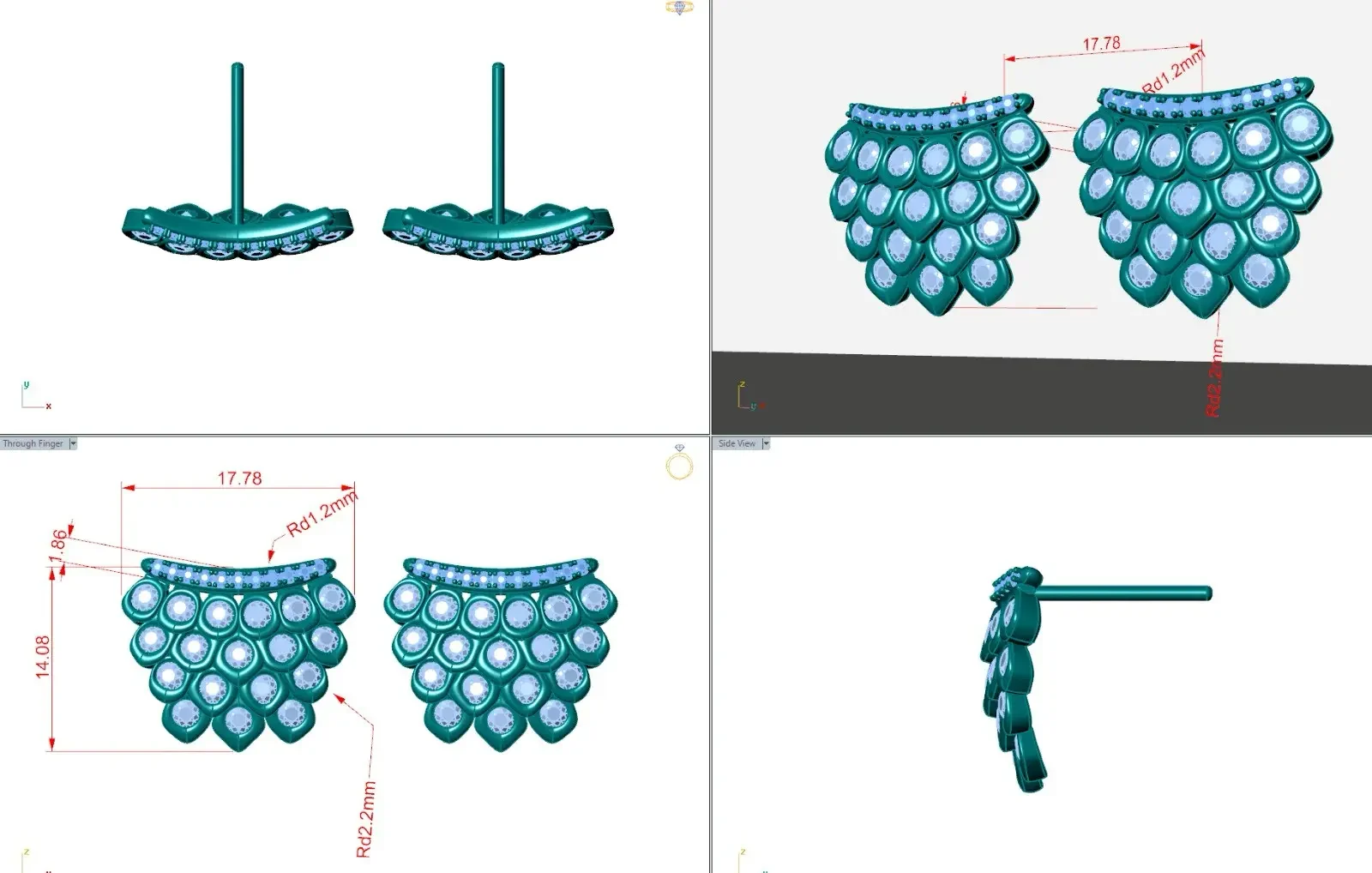
Before anything gets cast, ask for renderings from several angles, and make sure one of them is the profile view — that's where a lazy design shows up first. Get the dimensions written down: band width at the top of the shank and at the bottom, how high the setting sits, prong count. Ask to see it rendered on a hand at your finger size. And get the number of included revision rounds in writing, not in conversation.
A client last year wanted an 8mm band with a bezel-set center. On screen it looked balanced. The resin model came back and the bezel read nearly flat against that much metal, so the stone got swallowed by the band. We raised the bezel about a millimeter and reprinted. That correction cost three days and a few dollars of resin. Catching it after casting would have meant starting the ring over.
So if a design has unusual proportions — a wide band, a wide halo, a wedding band contoured to sit against a ring you already own — ask for a resin model before it's cast. A local shop hands it to you across the counter. We put ours in the mail and it arrives in a couple of days. Either way it costs almost nothing next to the mistake it prevents. Our guide to AI-assisted custom jewelry design covers how we get from a reference photo to a model worth printing.
Timelines
Three to five weeks from approved concept to finished ring is realistic. Design takes a few days. Revisions add days, not hours. Printing and casting sit on a production schedule. Then setting and finishing, and pavé takes longer than a solitaire because there's no fast way to cut seats for forty stones.
Driving to the store doesn't compress any of that if the store sends the work out. The shipping still happens; you just don't watch it. What does move the timeline is where the piece is physically made. Made here, a recast after a failed casting costs a few days. Made overseas, you're adding transit in both directions plus customs, and a single revision can turn into two extra weeks. If a shop gets vague when you ask where the work happens, ask again.
Sizing
This is where local has a real edge. A jeweler with a ring stick sizes a finger in half a minute, notices that your knuckle is much larger than the base of your finger, and adjusts a finished ring while you wait.
Remote sizing works, but it takes some care:
- Use a metal or plastic fit kit. Printed paper strips are unreliable and string is worse. Wear the sizer for a full day, including the evening, when hands swell.
- Size for the band you're getting. A 6mm band feels tighter than a 2mm band at the same size. Wide bands usually need a quarter to a half size more.
- Ask whether the design can be resized at all, before you approve it. Full eternity bands can't be. Pavé that runs all the way around, tension settings, and channel settings are difficult or expensive to change. If a design locks you into a size, you should hear that while it's still a picture.
- Get the resize policy in writing. Most studios include one free resize inside a set window. Ask how long the window is and how far they'll go.
Repairs, five and ten years out
Local wins on convenience. Tightening prongs, replating white gold, cleaning and inspection are all walk-in jobs, and a bench near your office is worth something over twenty years of wearing a ring.
The workaround is simpler than most people expect. Routine maintenance doesn't have to go back to whoever made the ring. Any competent local jeweler can tighten prongs, replate, and check a setting, and doing it nearby is usually faster and cheaper than shipping. What you want from the studio that built it is a written warranty on manufacturing defects and prepaid insured shipping when something is wrong with the work itself. Read the coverage terms for one clause in particular: whether outside work voids it. Check that before you hand the ring to somebody else.
Questions to ask either way
This list works the same whether you're standing in a store or sitting at your laptop. If anything, an online studio should be more forthcoming than a local one, since you can't walk in and look around.
- Who graded the stone. GIA or AGS for a center diamond. An unfamiliar lab report on a significant stone isn't automatically a problem, but it's a reason to slow down and ask more questions.
- How the deposit works. Paying something up front is normal, since design and casting cost money before you ever see the ring. Paying in full before you've seen a rendering is not.
- Return terms, split out. The policy on a loose stone and the policy on a finished custom mounting are two different things. Custom mountings are often non-returnable, which is fair, as long as you're told before you buy rather than after.
- An appraisal for insurance, included rather than sold to you afterward.
- Insured shipping with a signature required, in both directions.
- Karat stamping and a maker's mark, standard on legitimate work.
- Photos of the finished ring before it ships — the piece itself, not the rendering again.
When a local jeweler is the better call
There are cases where I'd send someone to a shop nearby. Hand engraving and antique restoration are the clearest. Machine engraving is everywhere, but true hand engraving, or repair on an old piece with fragile original metal, is a craft skill, and you want to see that person's work in person before you hand anything over. A hard deadline under two weeks also favors local, since a shop with its own casting equipment has the shortest path, though it's tight no matter who does it. And if you can't yet say whether you want a cathedral setting or a straight shank, an afternoon trying on twenty rings will teach you more than any consultation will. Go do that first, then decide where to build.
Heirlooms sit somewhere in the middle. Judging whether old stones can be reused and whether a mounting is worth saving is easier in hand, though good photos and an insured evaluation handle most of it. We walk through that process in our guide to remounting diamonds and gemstones.
When going online makes more sense
The case for remote comes down to a few situations. If your budget is fixed and you want as much of it as possible sitting in the ring, lower overhead helps, provided the quote is itemized enough for you to verify. If you already know what you want, reference photos and written revision rounds carry a specific vision better than describing it to a salesperson who relays it. If you care about the stone, virtual inventory is the difference between choosing among thirty and choosing among thousands. And if your local options are two chain stores and a repair counter, your zip code shouldn't set the ceiling on your ring.
There's a quieter advantage too. Working remotely pushes everything into writing: specs, timelines, revision counts, warranty terms. Two years later it's all still sitting in your inbox, which matters more than people expect the first time a question comes up about what was promised.
Common questions
Is custom jewelry more expensive than buying something ready-made?
Usually not, and often it's the other way around when you're comparing similar pieces. Custom skips the markup on a finished ring that's been sitting in a case, and it lets you put money into the parts you care about. Where custom does cost more is complexity: heavy hand finishing, unusual metals, or a lot of gold all add real labor and material.
How do I know an online jeweler will build what I approved?
The rendering is your contract. Approve one that has dimensions on it rather than just a nice picture, keep the approval in writing, and ask for photos of the finished piece before it ships. If what arrives differs from what you approved, that's a manufacturing error and it should be corrected at no cost to you. The written revision and warranty policy matters more here than a page of reviews does.
Can I insure a ring I bought online?
Yes. Insurers care about the grading report and a replacement-value appraisal, not the seller's address. If you want a second opinion, an independent appraiser in your city can examine the finished ring for a modest fee. On a purchase this size, that's money well spent.
What if it doesn't fit when it shows up?
Most studios include one free resize inside a set window. The exceptions are designs that can't be resized at all — full eternity bands and pavé that wraps around the shank being the usual ones. Ask about it while you're still looking at the design, when it can still be adjusted.
Can I buy the diamond locally and have it set somewhere else?
You can, but it creates a gray area. When one business supplies the stone and another sets it, responsibility for a chip during setting gets murky, and setting fees for an outside stone run higher. If you go this route, get that spelled out before the stone ships.
Making the call
Choose on who's doing the work rather than on whether there's a door you can walk through. A studio that controls its own design, bench, and sourcing will give you better information and a better price than a store acting as a go-between, and that studio might be twenty minutes away or three time zones away. The drawbacks of buying remotely are narrow and manageable: sizing, and not being able to drop in. The advantages, on stone selection and on where your money ends up, are larger.
If you already have a design in mind, bring the photos and a budget to a consultation and ask for an itemized quote and a timeline before you commit to anything. Anyone worth working with will hand you both.

Matthew Howe - Director of Operations — The Custom Jeweler
Matthew Howe has worked in diamonds since 2012, spending his first years alongside the buyers at a recycled and estate diamond wholesaler — learning how stones are graded, priced, and marked up well before they reach a retail case. He runs The Custom Jeweler day to day and still works client projects himself: the first call, the stone list, CAD approvals, and the last photos before a piece ships. Most of what he writes started as a question a client asked him on the phone.



.webp)